


2000*4000 cast iron platform, thick and durable.
Other Products


Industrial-Grade Robust Choice: Comprehensive Analysis of Test Bench Iron Floors
As essential infrastructure in industrial production and scientific research experiments, the design, materials, and functionality of test bench iron floors directly impact the accuracy of experimental data and operational safety. This article will analyze the structural characteristics, material selection, application scenarios, and maintenance key points to help readers understand the core value of this equipment.
I. Scientific Structural Design and Modular Innovation
Test bench iron floors typically feature a honeycomb reinforcement structure, achieving uniform load distribution through a crisscrossed 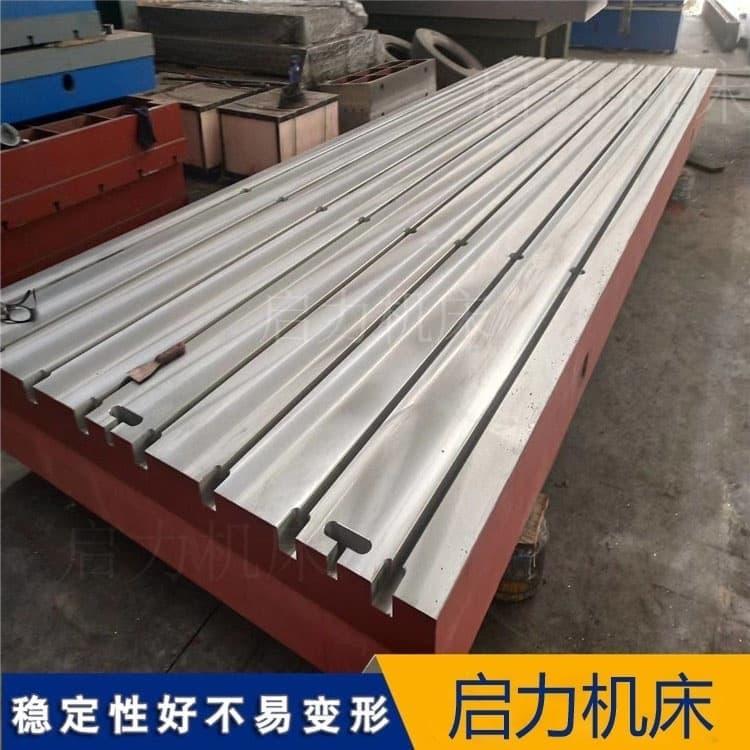
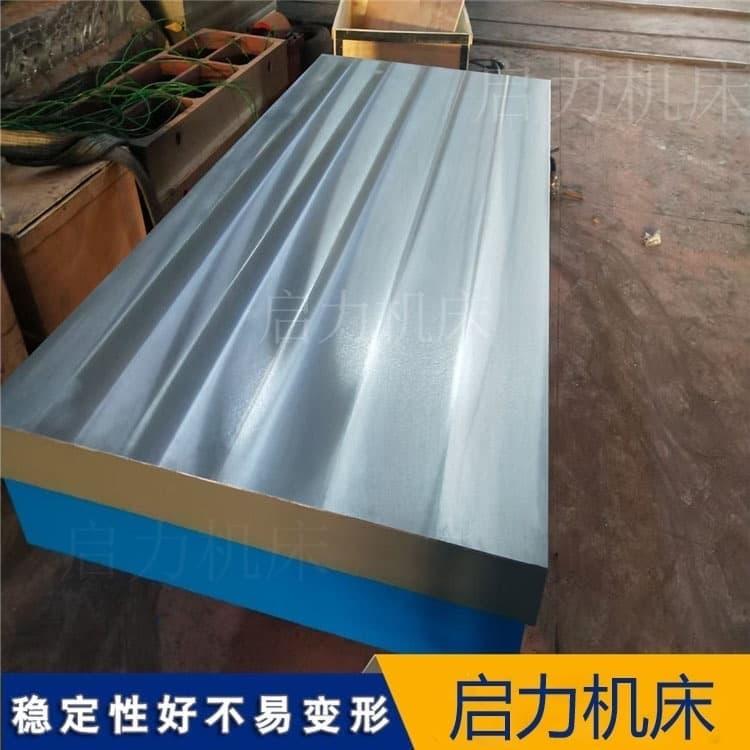 support skeleton. For example, a large 3.6m × 2.4m test bench used in laboratories has an 80mm thick floor with internal grid reinforcements spaced 150mm apart, combined with a 5mm thick anti-skid patterned steel surface, capable of withstanding a static load of 12t/m². Modern modular designs allow for functional expansion via quick-release bolts. For instance, an automotive R&D facility added a hydraulic lifting module to a basic platform, enabling the same test bench to accommodate both engine testing and full-vehicle vibration experiments.
Industry applications have also led to customized structures. Semiconductor laboratories commonly use magnetic levitation shock-absorbing floors, which control external vibration interference below 0.1μm through electromagnetic damping systems. In contrast, explosion-resistant test benches in certain fields employ a three-layer composite structure—an 8mm armored steel surface layer, a middle layer of Kevlar fiber cushioning, and a bottom layer of honeycomb aluminum energy absorption, capable of withstanding impacts equivalent to 200g of TNT at 5 meters.
II. Material Evolution and Surface Treatment Technologies
The upgrade from traditional cast iron to new alloys reflects the progress of industrial materials. Current mainstream solutions include:
1. Ductile Iron QT500-7: With a carbon content of 3.2%-3.6% and tensile strength of 500MPa, it is suitable for high-frequency impact testing environments. Tests in a wind tunnel laboratory showed that this material deforms less than 0.03mm/m under temperature cycles from -40°C to 150°C.
2. Stainless Steel 316L: An austenitic steel with 2%-3% molybdenum content, its annual corrosion rate in marine environments is only 1/20 that of ordinary carbon steel. Salt spray test data from a ship research institute indicated that electrolytically polished 316L floors showed no pitting after 3000 hours in a 5% solution.
3. Composite Solutions: A carbon fiber-reinforced aluminum matrix composite developed by a manufacturer reduces weight by 40% while maintaining a thermal expansion coefficient of 1.2×10⁻⁶/℃, meeting the stringent requirements of thermal vacuum testing.
Surface treatment technologies are equally critical. Laser texturing can create regular pits of 20-50μm on steel surfaces, increasing the friction coefficient to 0.7. Meanwhile, plasma nitriding forms a 0.1mm thick Fe hardening layer on the surface, achieving a microhardness of 1200HV and significantly enhancing wear resistance.
Test bench iron floors have evolved from simple support platforms into composite systems integrating materials science, structural mechanics, and smart sensing. Their technological advancements continue to push the boundaries of scientific research and industrial testing capabilities, achieving key breakthroughs in precision retention and functional integration.
Ms. Xie from Qili Machine Tool: 13785751790
| Industry Category | Hardware & Tools/Castings/Iron Castings |
|---|---|
| Product Category | |
| Brand: | 启力 |
| Spec: | 3000*5000 |
| Manufacturer: | 泊头启力机床 |
| Origin: | 111309 |


